

KEY TAKEAWAYS
- XRP is available on multiple regulated European exchanges with EUR support.
- SEPA transfers are usually the lowest-cost way to buy XRP in Europe.
- XRP network withdrawal fees are generally low compared with other blockchains.
- Destination tags are required when sending XRP to exchanges or custodial wallets.
- Hardware wallets offer the strongest long-term storage option for XRP holders.
XRP remains widely accessible across Europe through regulated platforms with EUR support and fast settlement. Low network fees and broad exchange coverage make access straightforward when basic rules are followed.
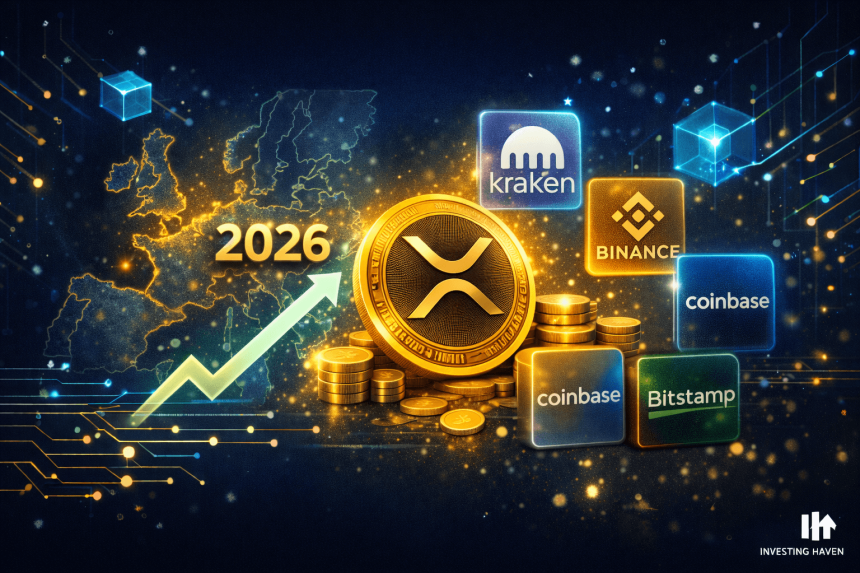
XRP has one of the most established trading footprints among large-cap cryptocurrencies in Europe. It is supported by multiple regulated exchanges, offers direct EUR trading pairs, and runs on a network designed for fast, low-cost transfers.
European buyers benefit from mature fiat infrastructure. SEPA bank transfers allow users to fund accounts at low cost, while card payments provide faster access when needed. Many exchanges also support direct XRP withdrawals to self-custody wallets, giving users control over storage.
Availability across Europe improved after major exchanges completed compliance reviews and restored XRP markets.
Today, you can choose between beginner-friendly platforms and advanced trading venues, depending on experience and cost sensitivity. The key decisions come down to fees, custody preferences, and ease of use rather than access itself.
RELATED: How To Buy Ripple (XRP) In The USA
Where To Buy XRP In Europe – Best Exchanges For XRP
You can buy XRP across several well-established European and global exchanges. Below are some of the best platforms to buy XRP in Europe:
eToro
eToro offers a simple way to buy XRP using EUR through a multi-asset platform that combines crypto with traditional markets. It is designed for ease of use and provides an optional wallet solution in supported European countries.
Best For
- Beginner investors who want a straightforward buying experience with fiat support.
Fees
- Spread-based pricing instead of order-book fees
- Fiat deposit and withdrawal fees depend on payment method
- Crypto wallet transfer fees vary by region
Pros
- Easy-to-use interface
- Strong regulatory presence in Europe
- Supports both crypto and traditional assets
Cons
- Spreads can be higher than on trading-focused exchanges
- Wallet functionality is not available in all countries
Crypto investments are risky and may not suit retail investors; you could lose your entire investment. Understand the risks here
RECOMMENDED: eToro Review 2025: Is It Safe, Legit & Worth It?
Kraken
Kraken supports direct XRP/EUR trading and is known for its structured fee model and security-focused design. It provides access to advanced order types while still supporting standard EUR funding methods.
Best For
- Users who want order-book trading with clear fee tiers.
Fees
- Maker and taker fees based on trading volume
- Higher fees for instant purchases
- Separate withdrawal and funding fees
Pros
- Direct XRP/EUR pair
- Transparent fee schedule
- Strong security controls
Cons
- Interface may feel complex for beginners
- Instant buy options cost more than limit orders
Binance (European Services)
Binance provides XRP access through its European services with high liquidity and low base trading fees. The platform is geared toward frequent traders and supports multiple fiat on-ramps, subject to local rules.
Binance recently applied for a EU-wide MiCA license in a move to widen its presence in Europe.
Best For
- Active traders focused on minimizing trading costs.
Fees
- Low maker and taker fees
- Flat network-based XRP withdrawal fee
- Discounts available through platform incentives
Pros
- Deep liquidity for XRP markets
- Competitive trading fees
- Broad range of trading tools
Cons
- Feature availability varies by country
- Platform may feel overwhelming for new users
Coinbase
Coinbase offers XRP access through a clean and simple interface that prioritizes ease of use and regulatory clarity. It is widely used across Europe but tends to cost more for basic buy-and-sell transactions.
Best For
- Users who prioritize simplicity and brand trust.
Fees
- Higher fees for instant buys
- Clear fee breakdown before order confirmation
- Lower costs on advanced trading interface
Pros
- Very user-friendly
- Strong compliance focus
- Clear transaction summaries
Cons
- More expensive than order-book exchanges
- Limited control for basic buy options
Bitstamp
Bitstamp is one of Europe’s longest-running exchanges and supports XRP with direct EUR trading. Its fee structure is simple and predictable, making it appealing to users who value transparency.
Best For
- European users seeking a straightforward exchange with SEPA support.
Fees
- Volume-based trading fees
- Low flat XRP withdrawal fee
- Minimal complexity in fee structure
Pros
- Established European presence
- Simple and predictable costs
- Reliable fiat banking rails
Cons
- Fewer advanced trading features
- Lower liquidity than very large global platforms
RECOMMENDED: How To Buy XRP In Australia (2026 Guide: Exchanges + Fees)
How To Buy XRP In Europe On eToro
We recommend eToro because it offers a simple EUR on-ramp, regulated access, and an intuitive interface, making it a practical choice for first-time XRP buyers in Europe.
Here is a step-by-step guide to buy XRP on eToro,
1. Create an Account

Sign up on eToro and complete identity verification (KYC). eToro requires ID and proof of address for fiat deposits and withdrawals. Verification unlocks EUR funding and trading.
2. Fund Your Account

Choose SEPA bank transfer for the lowest cost where available. Card deposits work if you need faster access but often cost more. eToro shows available deposit methods when you click “Add Funds.”
3. Buy XRP

Search “XRP” in Markets, choose Trade, then enter the amount in EUR or the number of XRP you want. Review the spread and estimated fees shown on the confirmation screen, then confirm the trade. eToro uses spread-based pricing rather than a classic maker/taker order book.
4. Move XRP to Your Wallet (Optional)

If you want self-custody, transfer XRP from your eToro investment account to the eToro Crypto Wallet (where supported).
Use the platform’s “Transfer to Wallet” flow and confirm both the wallet address and any required destination tag. The wallet app shows step-by-step instructions for sending and receiving.
5. Withdraw to an External Wallet
When withdrawing XRP to another exchange or custodial address, always include the destination tag if the recipient requests one. Missing the tag can delay crediting or require manual recovery. Check the recipient’s deposit page for the exact address and tag.

RECOMMENDED: An In‑Depth Review of Buying XRP on eToro
Where To Store XRP: Best Wallets For XRP In Europe
There are four main wallet types for XRP:
- Hardware
- Mobile/desktop self-custody
- Custodial/exchange wallets
- Paper/offline backups
Each type balances security, convenience, and cost differently. Pick the type that matches how often you move funds and how much control you want over private keys.
Hardware Wallets
Hardware wallets are physical devices that store private keys offline and sign transactions without exposing the keys to the internet. They protect large balances from online attacks and integrate with desktop or mobile companion apps to view and broadcast signed transactions. They require physical safekeeping and occasional firmware updates.
Pros
- Strongest protection against online theft
- Good for large, long-term holdings
- Works with many wallet apps for XRP signing
Cons
- Purchase cost and physical storage required
- Slightly more steps to send funds
- Risk of loss or damage if not backed up
Recommended Wallets
- Ledger (Nano S/X)
- Trezor (Model T / Suite integration)
Mobile / Desktop Self-Custody Wallets
Self-custody apps run online on phones or computers and give you direct control of the seed phrase and private keys. They make everyday transfers and XRPL app interactions simple. These wallets are convenient but inherit the security risks of the device they run on.
Pros
- Fast access for daily use and dApps
- Free or low cost to use
- Often XRPL-native features (hooks, memo handling)
Cons
- Vulnerable if the device is compromised
- Users must secure and back up seed phrases
Recommended Wallets
- XUMM
- Xaman
- Trust Wallet
- Exodus
Custodial / Exchange Wallets
Custodial wallets are accounts where a third party holds your private keys, typically an exchange or custodial service. They simplify fiat on/off ramps and instant trading but require trust in the provider’s security and policies.
Pros
- Easiest for buying, selling and quick trades
- Often offer fiat rails and insured custody options
Cons
- You do not control private keys
- Risk depends on provider security and policy changes
Recommended Providers
- Kraken, Binance, Coinbase, Bitstamp, eToro (exchange wallets vary by region)
Paper / Offline Seed Backup
A paper or offline seed backup records your recovery phrase in physical form and keeps it disconnected from networks. It removes the digital attack surface but creates physical risks and requires careful storage and redundancy.
Pros
- No online attack surface
- Low cost to create
Cons
- Vulnerable to loss, theft, fire, or damage
- Requires secure, redundant storage locations
Examples
- Handwritten paper backup
- Metal seed plate
- Offline printed copy
RECOMMENDED: Is XRP Dead? Here’s Why Crypto Forums Are Going Crazy
Crypto Regulation In Europe
The EU built a single rulebook for crypto with the Markets in Crypto-Assets (MiCA) framework. MiCA sets licence, governance and consumer-protection rules for crypto-asset service providers (CASPs), and it requires firms offering services in the EU to meet authorisation and transparency obligations.
Practical effects for buyers in Europe are as follows:
- Providers must perform robust KYC and anti-money-laundering checks before serving customers. This reduces anonymous access and standardises customer onboarding across many member states.
- Exchanges must hold appropriate governance, incident-reporting and safeguarding arrangements. These rules aim to protect client assets and improve operational resilience.
- Supervisory work continues at national and EU levels; regulators (including ESMA) publish guidance and warn firms against misleading marketing or inconsistent compliance. Expect ongoing supervisory updates and occasional national adaptation periods.
MiCA entered implementation in stages. Some technical and supervisory acts rolled out after the core regulation came into force; member states have used permitted transition windows in specific cases.
Check your local regulator for final licensing timetables and any national adaptation extensions.
RECOMMENDED: How To Buy Ripple (XRP) In The USA
Reasons To Buy XRP In Europe
XRP fits well with European needs for fast settlement, low transfer costs, and broad exchange support. Below are some reasons you should include XRP in your crypto portfolio in Europe.
Fast, Low-Cost Transfers
The XRP Ledger settles transactions in seconds and uses very small network fees. This makes moving funds between wallets or exchanges quick and inexpensive.
Strong Exchange Coverage
Many regulated European platforms list XRP and offer EUR on-ramps. That reduces the number of conversion steps when entering or exiting positions.
Predictable Transaction Behavior
XRP transactions do not face the same congestion patterns as some newer networks. Users get consistent confirmation times and fewer failed transfers.
Practical For Cross-Border Flow
For users moving value across countries, XRP’s speed and low fees cut the time and cost compared with many other crypto options.
Established Wallet and Tooling Support
Hardware wallets, mobile apps, and XRPL-native tools all support XRP, giving buyers clear choices for custody and transaction management.
RECOMMENDED: 5 Reasons to Buy XRP
Tips For Buying XRP In Europe
- Use SEPA bank transfers to fund EU accounts when available. SEPA payments usually carry lower fees than card deposits and reduce the total cost of entry, especially for larger purchases. Card payments are faster, but the added convenience often comes with higher charges.
- Always complete required KYC before trading or withdrawing. Under MiCA and AML rules, exchanges must verify identity before enabling full access. Delaying verification can block withdrawals at critical moments.
- Confirm the recipient’s destination tag when sending XRP to exchanges or custodial wallets. XRP uses shared addresses, and the tag identifies your account. Missing it can stop automatic crediting. Send a small test transfer first to avoid recovery delays.
- Compare total cost, not just trading fees. Include spreads, deposit charges, and withdrawal fees. Some exchanges apply small fixed XRP withdrawal fees, which still affect frequent transfers.
- Use hardware wallets for significant holdings. Keep only active trading balances on exchanges. Ledger and Trezor both support XRP and integrate with XRPL tools for secure self-custody.
RECOMMENDED: Forget BTC & ETH – Here’s Why Experts Are Calling XRP The Hottest Crypto Of 2026
FAQs
Can I Buy XRP With EUR?
Yes. Major European exchanges offer XRP/EUR trading pairs or EUR on-ramps. Check the exchange’s markets page for EUR availability.
Do I Need a Destination Tag When I Send XRP?
If you send XRP to an exchange or shared address, include the destination tag. The XRPL uses tags to identify recipients within a shared address.
Which Wallet Type Is Safest?
Hardware wallets (offline devices) provide the strongest protection for large, long-term holdings. Ledger and Trezor document native XRP support.
Will Exchanges Continue to Operate Under MiCA?
Exchanges can operate if they meet authorisation, KYC and governance rules. National timeframes for full authorisation may vary; consult the exchange and your regulator.
RECOMMENDED: ZCash Vs XRP: Which Is A Better Buy?
Conclusion
Buying XRP in Europe is straightforward when you pick a regulated exchange, complete KYC, and follow XRPL rules like destination tags. Use SEPA for low deposit costs, compare total fees, and store significant balances in hardware wallets to reduce custody risk.
Check local regulator pages for any national MiCA updates.
Should You Buy XRP Now?
While you may be keen to buy XRP now, it may be worth checking our latest Premium Crypto Alert first.
We have been guiding crypto investors since 2017, helping readers navigate both major bull markets and deep crypto winters.
Our ethos is to identify a small number of cryptocurrencies with the strongest potential.
Each week, we publish a Premium Crypto Alert highlighting the cryptocurrencies currently showing the most promising setups.
You can explore more of our premium crypto research and forecasts here: Premium Crypto Alert Service