


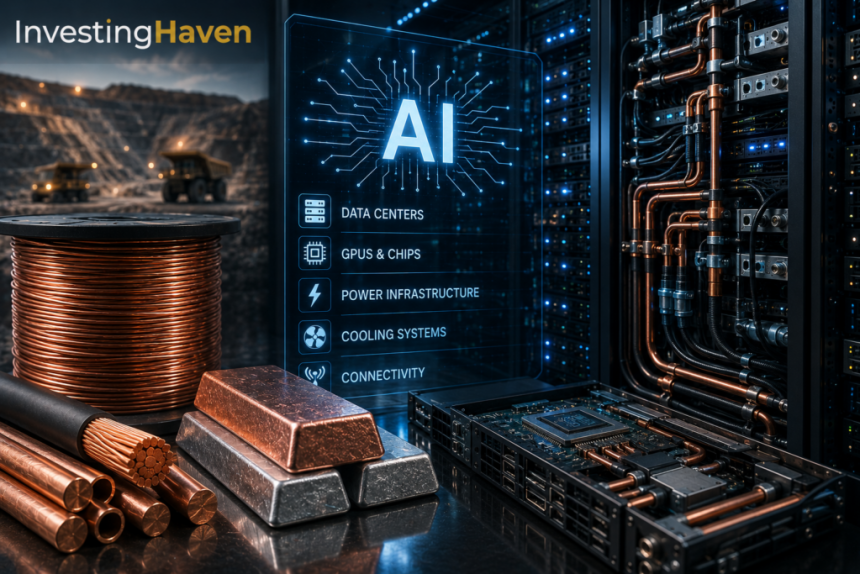
Artificial intelligence has ignited a massive global race for computing power, but the ultimate bottleneck to this technological revolution may not come from advanced silicon chips. Instead, it may come from a far more traditional commodity: copper.
Every AI query routed through a neural network travels through a complex physical architecture packed with copper-intensive infrastructure.
From high-voltage power cables and distribution transformers to liquid cooling systems, electrical substations, server racks, and long-distance transmission lines, copper is the indispensable element making artificial intelligence possible.
As hyperscalers build increasingly massive AI data centers, global electricity demand is climbing sharply. The International Energy Agency (IEA) expects global data-center electricity consumption to more than double by 2030, driven largely by the relentless expansion of AI workloads.
Building out this infrastructure does not merely require advanced graphics processing units (GPUs); it demands an enormous expansion of physical power networks, with copper sitting squarely at the center of nearly every layer.
Key Takeaways
- The Hidden Boom: AI expansion is driving an unprecedented, hidden copper boom through data-center construction, grid modernization, power systems, and high-density cooling infrastructure.
- The Grid Constraint: Physical electricity infrastructure has emerged as a primary constraint for tech firms, as legacy utility grids struggle to support rapidly growing AI power demands.
- The Supply Mismatch: Copper supply cannot easily scale to match tech-sector demand because new mines, refining capacity, and regional transmission projects take years to permit and construct.
RECOMMENDED: Top 3 Metals to Buy for the Clean-Energy Transition: Copper, Nickel, Silver
Why AI Data Centers Are Turning Copper Into a Strategic Metal
Most market participants focus exclusively on cutting-edge GPUs and specialized accelerators when discussing the AI economy. However, modern data centers depend just as heavily on physical commodities.
An advanced AI facility utilizes vast quantities of copper in power distribution units (PDUs), battery backup systems, step-down transformers, high-speed networking equipment, and high-density clustering cables.
Because AI servers operate at significantly higher densities and consume far more electricity than traditional cloud computing workloads, operators are being forced to dramatically expand localized cooling systems and high-voltage grid connections.
The sheer scale of this transition is enormous. Wall Street analysts have begun quantifying this structural shift; Goldman Sachs estimates that overall data-center power demand could rise 165% by 2030 compared with 2023 levels.
This projected growth creates a parallel surge in industrial metal demand, as every additional megawatt of data-center capacity requires a corresponding increase in heavy-gauge wiring, specialized substations, and regional transmission capacity.
Copper has effectively become the circulatory system of AI infrastructure.
The Copper Supply Problem Could Slow AI Expansion
The core challenge facing the technology sector is not simply rising demand, but a profound structural speed mismatch between software-driven AI growth and extractive physical supply chains.
AI infrastructure can scale within a matter of months, restricted only by chip fabrication lead times. Copper production enjoys no such agility.
Developing new, large-scale copper mines often takes upwards of a decade to move from initial discovery through permitting and full commercial production.
Furthermore, global refining capacity remains heavily concentrated in a handful of countries, while utilities are already grappling with extended lead times and acute supply shortages for critical equipment like electrical transformers, high-voltage transmission gear, and industrial cable.
This friction is occurring at a time when power grids in major AI hubs – such as Northern Virginia and parts of Europe – are already operating under noticeable strain.
The IEA warns that widespread grid bottlenecks and lengthy interconnection queues could delay a meaningful share of planned data-center projects by the end of the decade.
This dynamic introduces a stark new reality for the digital economy: long-term access to reliable electricity and physical copper may prove just as critical to scaling AI as securing advanced silicon allocations.
The global AI race increasingly resembles a traditional infrastructure race.
Technology companies are no longer competing solely for allocation of semiconductors; they are actively vying for long-term power purchase agreements (PPAs), grid access, industrial land, and copper-heavy electrical systems.
What This Means for Investors and the AI Industry
Consequently, utility providers, base-metal mining firms, industrial cable manufacturers, and transmission equipment suppliers look poised to become some of the most significant indirect beneficiaries of the generative AI boom.
For market participants, this macro backdrop suggests that copper may no longer represent merely a cyclical industrial commodity tied strictly to traditional construction or manufacturing data.
Instead, it is increasingly viewed as a strategic asset linked directly to the structural expansion of secular technology trends.

We have done a full analysis of precious metals at the center of the AI boom. We reveal metals that could likely double in value this decade because of AI. Subscribe to our premium alerts for unlimited access.
Conclusion
While copper rarely receives the headlines in mainstream artificial intelligence commentary, the entire digital frontier depends heavily on its availability.
Advanced chips may power the algorithms of artificial intelligence, but copper provides the physical electricity, high-speed connectivity, and robust infrastructure that allow those models to scale globally.