

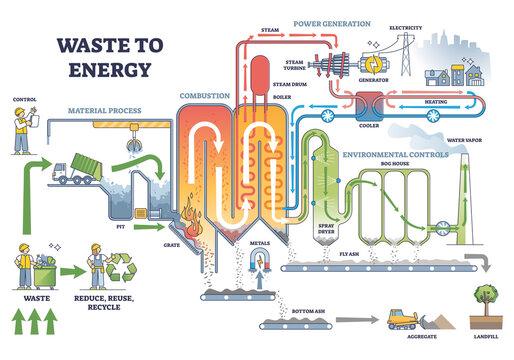
Waste to Energy Market
The Global Waste to Energy Market reached US$ 38.5 billion in 2023 and is expected to reach US$ 68.7 billion by 2031, growing with a CAGR of 7.5% during the forecast period 2024-2031.
Market growth is driven by escalating global waste generation, tightening environmental regulations on landfills, and the push for renewable energy sources amid climate change imperatives. Advancements in waste-to-energy technologies like gasification and plasma arc systems, rising demand for sustainable waste management in urbanizing regions, government incentives for circular economy initiatives, and increasing investments in ESG-compliant infrastructure are further accelerating market expansion.
Get a Free Sample PDF Of This Report (Get Higher Priority for Corporate Email ID):- https://www.datamintelligence.com/download-sample/waste-to-energy-market?ram
Key Industry Developments
Europe:
✅ January 2026: Veolia Environnement SA launched an advanced plasma arc gasification reactor in Paris, France, achieving 98% waste volume reduction and producing syngas for green hydrogen applications, supporting EU circular economy goals with near-zero landfill output and integrated flue gas treatment. This R&D innovation features AI-driven process controls to optimize energy yield from mixed MSW while capturing over 95% of emissions for industrial reuse.
✅ November 2025: Hitachi Zosen Inova AG unveiled a next-generation combined heat and power (CHP) incineration system in Copenhagen, Denmark, boosting energy efficiency to 85% through steam optimization and flue gas heat recovery, powering district heating for 100,000 households amid Nordic net-zero transitions.
✅ October 2025: Martin GmbH for der Umwelt- und Energietechnik introduced high-temperature pyrolysis technology at a facility in Stuttgart, Germany, converting non-recyclable plastics into oil and gas with 90% carbon utilization, aligning with Germany’s Pfandgesetz waste reforms and advancing chemical recycling scalability.
United States:
✅ January 2026: Covanta Energy launched an advanced plasma gasification system at its Honolulu facility, converting municipal solid waste into syngas with 95% higher efficiency than traditional incineration, reducing landfill use by 80% and enabling cleaner renewable energy production for local grids. This R&D breakthrough integrates AI-optimized feedstock processing to minimize emissions while maximizing syngas yield for industrial applications.
✅ November 2025: Anaergia Inc. unveiled a next-gen anaerobic digestion technology in California, featuring modular bioreactors that process organic waste 30% faster, producing biogas with elevated methane content for vehicle fuel conversion and supporting California’s zero-waste mandates.
✅ October 2025: Waste Management (WM) announced R&D advancements in hydrothermal carbonization at its Texas plant, transforming wet waste into hydrochar fuel with zero wastewater discharge, a key step toward scalable carbon-negative energy solutions amid rising ESG compliance pressures.
Strategic Mergers and Acquisitions:
✅ Blue Planet Environmental Solution India Pvt. Ltd. acquired Mahindra Waste to Energy Solutions Limited (MWTESL) in February 2024 (announced prior to 2025 but relevant to market consolidation), enhancing waste-to-energy innovation through Bio-CNG production from municipal waste and carbon capture technologies.
Key Players:
Covanta Energy | China Everbright | Suez Environment (SITA) | Veolia Environmental | Viridor | Keppel Seghers Belgium N.V. | MVV Energie AG | China Metallurgical Group | Fluence Corporation | Waste Management Inc.
Strategic Leadership Report: Top 5 Players in Waste to Energy Market 2026
-Covanta Energy: Deployed advanced gasification technology at its Honolulu facility, converting municipal solid waste into syngas for cleaner electricity generation while reducing landfill use and emissions through integrated carbon capture systems.
-China Everbright: Launched a next-generation waste-to-energy plant in Shenzhen with AI-optimized combustion controls, achieving over 30% higher energy recovery efficiency from mixed waste streams and enabling district heating for urban sustainability.
-Suez Environment: Introduced the Loop Energy platform featuring modular anaerobic digestion units, transforming organic waste into biogas for renewable power and fertilizers, with real-time monitoring to enhance circular economy outcomes.
-Veolia Environmental: Expanded its WtE portfolio with the e-Boiler hybrid system at Paris facilities, combining incineration and electrification to boost thermal efficiency and support green hydrogen production from captured waste heat.
-Waste Management Inc.: Rolled out the Ignite digital suite for WtE operations, integrating IoT sensors for predictive maintenance and emissions optimization across North American plants, driving higher uptime and compliance with 2026 net-zero standards.
Buy Now & Unlock 360° Market Intelligence: https://www.datamintelligence.com/buy-now-page?report=waste-to-energy-market?ram
Market Drivers and Key Trends:
-Rising Waste Volumes: Escalating global municipal solid waste generation, projected to exceed 3.4 billion tons by 2050, drives demand for waste-to-energy (WtE) solutions to manage urban waste surges while generating renewable power.
-Circular Economy Push: Transition to circular economy models positions waste as a resource, enabling energy recovery, cost savings on disposal, and revenue from electricity, heat, and byproducts like biochar.
-Government Incentives: Policy support via subsidies, public-private partnerships, and landfill diversion mandates accelerates WtE adoption, especially in Asia-Pacific leaders like China, India, and Japan.
-Tech Advancements: Innovations in thermal technologies, incineration, anaerobic digestion, AI-driven monitoring, and automation boost conversion efficiency and economic viability.
-Energy Security: WtE provides baseload renewable power, reduces fossil fuel reliance, and supports sustainability goals amid rising energy needs.
-Market Hurdles: High upfront capital costs, regulatory complexities for emissions, and public opposition to facilities constrain scalability despite growth projections to USD 70+ billion by 2032.
Regional Insights:
-Europe: 42% (Largest share, driven by advanced waste management infrastructure and strict EU regulations on landfill diversion).
-Asia Pacific: 28% (Fastest growing, fueled by rapid urbanization, rising waste volumes in China and India, and government incentives for renewable energy).
-North America: 15% (Supported by established facilities in the US and Canada, with steady growth from sustainability mandates).
Market Opportunities & Challenges: Waste to Energy Market 2026
-Opportunities: Urbanization-fueled “Landfill Diversion Mandates” accelerate thermochemical plant deployments; Asia-Pacific public-private partnerships and circular economy policies enable biochemical syngas upgrades for grid-independent power.
-Challenges: Feedstock variability disrupts gasification efficiency amid “2025 EU Emission Caps,” while aging incinerator retrofits face skilled labor shortages. Success demands modular plasma tech navigation of permitting delays.
-Strategic Verdict: Advanced pyrolysis platforms and AI-optimized biogas systems propel high-yield 2026 expansions.
Speak to Our Analyst and Get Customization in the report as per your requirements: https://www.datamintelligence.com/customize/waste-to-energy-market?ram
Market Segmentation Analysis:
-By Technology: Thermal Dominates with Combustion Efficiency
Thermal technology leads at 65% market share in 2024, leveraging incineration and gasification for high-volume energy recovery from diverse waste streams.
Biological processes hold 25%, using anaerobic digestion and fermentation for organic waste-to-biogas conversion, ideal for sustainable methane capture.
Others, including plasma arc and pyrolysis, claim 10%, offering advanced emission control but facing scalability hurdles.
-By Waste Type: Solid Waste Commands Largest Volume
Solid waste dominates at 70% share, encompassing municipal trash and industrial refuse converted via thermal/biological routes for electricity generation.
Liquid waste follows at 20%, from sewage and industrial effluents processed biologically for biofuel production.
Gaseous waste takes 10%, recycling landfill methane and biogas streams for direct energy harnessing.
Unlock 360° Market Intelligence with DataM Subscription Services: https://www.datamintelligence.com/reports-subscription?ram
Power your decisions with real-time competitor tracking, strategic forecasts, and global investment insights all in one place.
✅ Competitive Landscape
✅ Sustainability Impact Analysis
✅ KOL / Stakeholder Insights
✅ Unmet Needs & Positioning, Pricing & Market Access Snapshots
✅ Market Volatility & Emerging Risks Analysis
✅ Quarterly Industry Report Updated
✅ Live Market & Pricing Trends
✅ Import-Export Data Monitoring
Have a look at our Subscription Dashboard: https://www.youtube.com/watch?v=x5oEiqEqTW
Contact Us –
Company Name: DataM Intelligence
Contact Person: Sai Kiran
Email: Sai.k@datamintelligence.com
Phone: +1 877 441 4866
Website: https://www.datamintelligence.com
About Us –
DataM Intelligence is a Market Research and Consulting firm that provides end-to-end business solutions to organizations from Research to Consulting. We, at DataM Intelligence, leverage our top trademark trends, insights and developments to emancipate swift and astute solutions to clients like you. We encompass a multitude of syndicate reports and customized reports with a robust methodology.
Our research database features countless statistics and in-depth analyses across a wide range of 6300+ reports in 40+ domains creating business solutions for more than 200+ companies across 50+ countries; catering to the key business research needs that influence the growth trajectory of our vast clientele.
This release was published on openPR.